services
Immunoassay Development:
Lateral Flow Assay Development & Manufacturing
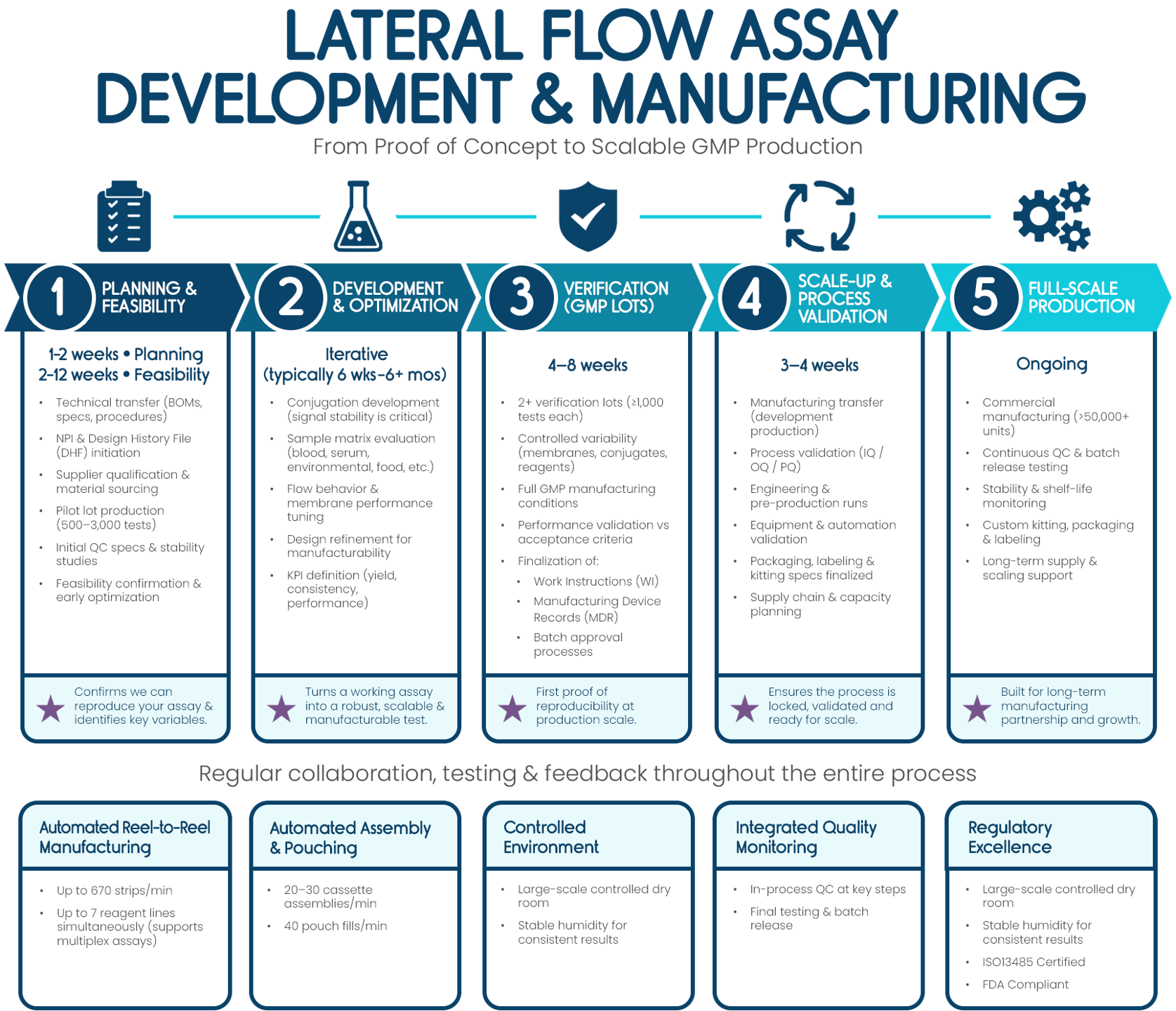
Ethos Biosciences provides lateral flow assay development and manufacturing for teams that are working to move an assay from early feasibility into a reproducible and scalable format. Our work spans development, design transfer, and production, all with scientists and manufacturing teams that are operating within the same facility to keep their performance aligned with real production conditions. We have the flexibility to help teams at any stage of development and manufacturing.
Our team brings more than 20 years of experience developing and manufacturing lateral flow assays. Current and past projects include clinical, veterinary, environmental, and food safety applications.
We work closely with our customers once they have a concept. Once developed and validated, Ethos Biosciences uses our 126,000 square foot facility in New Jersey to manufacture using state-of-the-art reel-to-reel dispensers, as well as an automated assembly line that can handle 20-30 cassette assemblies/minute and pouch filling at 40 pouches/minute.
Development Capabilities
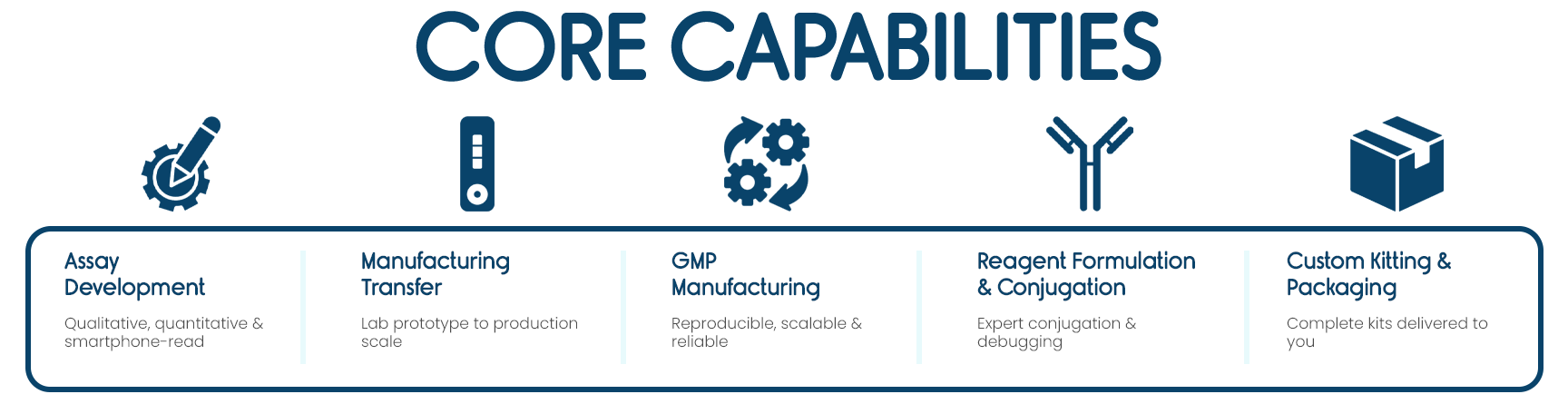
Assays are developed across a range of detection methods, including visual formats or systems that rely on external readers like smartphones. These approaches allow for qualitative, semi-quantitative, or quantitative outputs depending on the application.
Design work may involve a single analyte or a multiplexed format, where multiple targets are detected within the same test. Device configurations are also considered, including cassette-based formats that provide a more controlled user interface, while strip-based formats may be used in semi-trained environments or where cost constraints are a factor.
Sample type and matrix effects are evaluated during development as these often influence how the assay performs once it has reached scale. Blood, serum, environmental samples, and food matrices each introduce different variables that have to be accounted for in flow behavior and signal development.
In many assays, the visible signal is generated by nanoparticles such as colloidal gold, which have to remain stable and flow consistently through the test strip. Conjugation methods, where detection molecules are attached to these particles, are addressed as part of the development to maintain release and flow reproducibility.
Manufacturing and Scale
Our manufacturing process is structured around controlled and repeatable processes rather than manual assembly. Reel-to-reel systems apply reagents and assemble materials in a continuous format, supporting uniform production at scale.
Environmental conditions are managed within a dedicated dry room. The humidity control helps preserve reagent stability and consistent material behavior during processing and packaging. Automated cassette assembly and pouching help reduce further handling that would introduce debris or variability into the assay while also increasing throughput.
Production can begin at lower volumes and scale as needed, with batch sizes typically ranging from 1,000 to 50,000 devices and expanding beyond as demand increases. They can be supported without having to return to the design stage, as the same manufacturing approach can be maintained regardless of batch size. Our facility is built to be expanded quickly which allows us to continue to grow operations of any size for our customers.
Quality control is applied throughout the manufacturing process, including checking incoming materials, in-process monitoring, and final testing to confirm that each batch meets defined specifications. Manufacturing is performed under ISO 13485:2016-certified conditions in an FDA-registered facility, with processes aligning to GMP requirements.
If you’d like to learn more, please contact us!